Alfaqix
Raymond Larabie / Typodermic Fonts Inc. · Regular · Alfaqix
Previsualiza esta fuente, revisa los detalles del archivo y descarga el paquete completo del diseñador.

Sobre esta fuente
Licencia / Copyright: Free desktop license — see included Typodermic EULA
Nota del autor:
Official free desktop-license package from Typodermic Fonts Inc.
Included font files: AlfaqixAlgorithm-SemiBold, AlfaqixDiode-SemiBold, AlfaqixEllipsoid-SemiBold, AlfaqixServo-SemiBold.
Download and retain the complete original ZIP, including read-this.html and the Typodermic Desktop EULA 2026.pdf. The included EULA governs use. This package covers only the listed styles; other styles in the commercial family are not included.
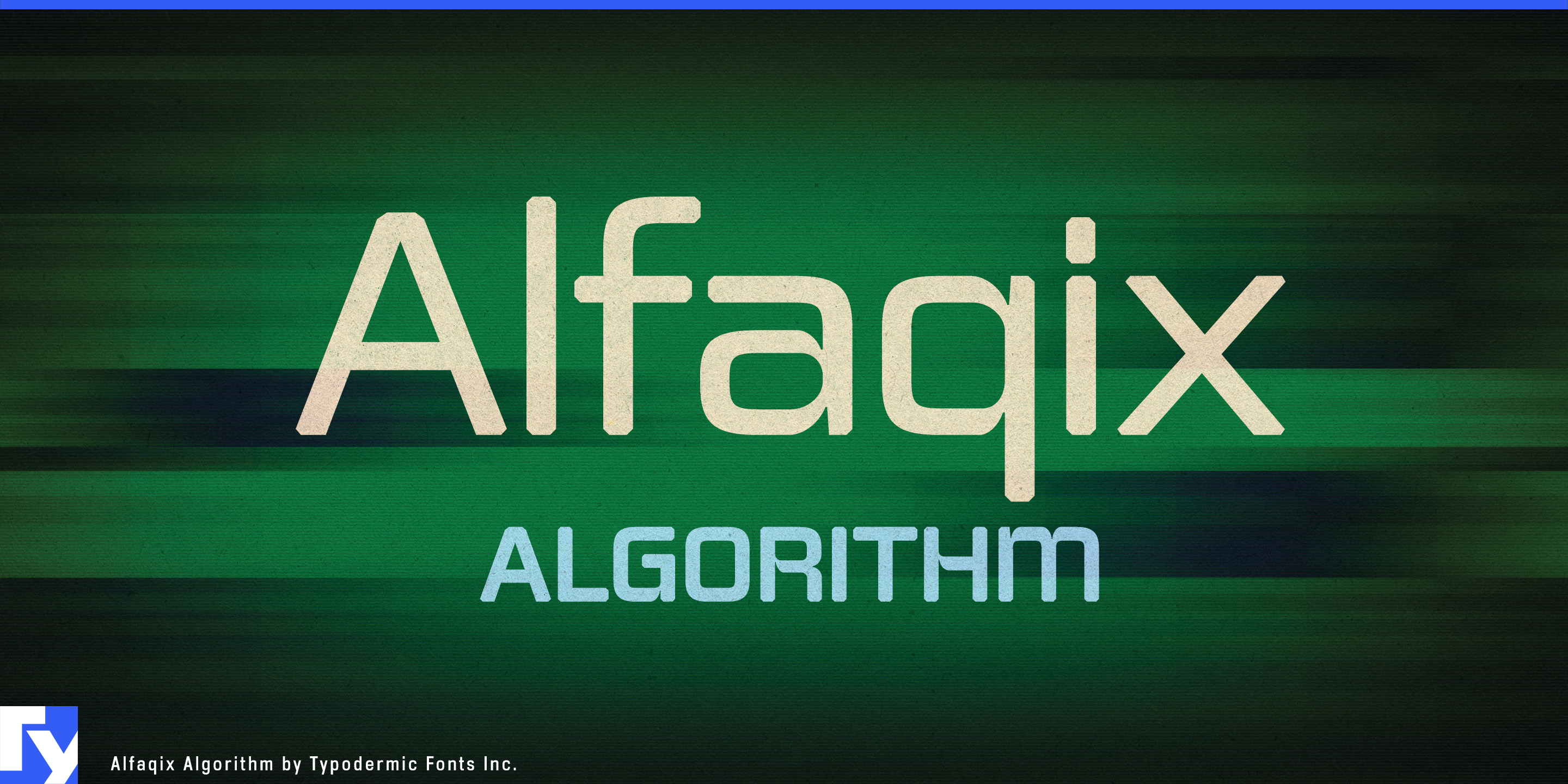
Alfaqix Algorithm
Technical products often need typography that looks engineered without looking fictional. A conventional sans can make sophisticated equipment or software feel generic; a heavily stylized techno face may establish the mood quickly but becomes awkward when the same system needs headings, labels, diagrams and short explanatory text. Alfaqix Algorithm occupies the useful territory between those extremes.
Its modular letterforms are squared and geometric, with clipped, octagonal stroke ends that give the family a machined quality without turning every character into a special effect. That makes Algorithm particularly effective for scientific and industrial instruments: laboratory analyzers, environmental sensors, diagnostic machines, measurement equipment and other devices where a product name shares space with modes, specifications and technical information. Bold and SemiBold can identify the machine or system, while lighter weights carry the same visual language into supporting material.
Energy and infrastructure technology present a similar opportunity. Battery-storage systems, solar inverters, EV charging equipment, smart-grid software and building-control systems all combine physical hardware with screens, diagrams and data. Algorithm can move naturally from an equipment model name or enclosure graphic to dashboard headings, status categories and technical diagrams.
The same restraint suits medical technology, biotech and research environments. Diagnostic equipment, laboratory automation, genomic research software and pharmaceutical R&D systems can use Algorithm for product-family names, instrument markings, conference graphics, software headings and data displays without drifting into decorative science fiction.
For network monitoring, cybersecurity and other information-heavy systems, Algorithm works especially well as the distinctive layer in a hierarchy. It can handle section headings, machine names, telemetry labels and incident-report titles while a conventional text face takes care of dense tables and continuous reading.
Part of the Alfaqix modular family, Algorithm is distinguished by its chamfered terminals and unusually practical balance between technical character and usability. Its four weights with matching italics give laboratory instruments, energy platforms, industrial technology and technical interfaces a consistent visual system that looks engineered rather than merely typeset.
Alfaqix Diode
A digital readout is excellent at showing a time, score or measurement. Ask it to handle a competitor’s name, an event title, a category label or a few words of explanation and its limitations become obvious. Alfaqix Diode takes the visual language of electronic displays and turns it into a complete typographic system, retaining the segmented, machine-generated character while providing a full alphabet, four weights and matching italics.
That makes Diode especially useful for sports timing and competition graphics. Race clocks, lap counters, swimming results, cycling events, motorsport telemetry and tournament displays all revolve around information that is measured, ranked or continuously updated. Large numerals can carry the score, elapsed time or speed while the same family continues into competitor names, event headings, classifications and supporting labels.
Broadcast and streaming graphics present the same challenge. Sports coverage and racing broadcasts need standings, statistics, speeds, rankings and changing status information alongside ordinary words and names. Diode keeps those elements visually connected to the data being shown without forcing the designer to combine a literal digital-number font with an unrelated alphabet.
Electronic music hardware offers another natural setting. Synthesizers, drum machines, samplers, DJ controllers and effects processors live among parameter values, small screens, status indicators and model numbers. Diode can bring that vocabulary into instrument names, software-synth titles, preset graphics, product launches and trade-show displays while remaining flexible enough for more than brief electronic readouts.
Fitness equipment and training systems provide a similar mixture of words and measurements. Treadmills, exercise bikes, rowing machines and performance apps constantly present elapsed time, resistance, distance, repetitions and speed. Diode can establish model names, workout categories and statistical headings while keeping them visually related to the numbers around them.
Part of the Alfaqix modular family, Diode is distinguished by the segmented electronic construction built into its letterforms. Where a simple digital display handles a few numbers or symbols, Diode extends that visual language into names, headings, labels and complete information hierarchies. It is most at home when the typography needs to look as though the score, time, speed or status came directly from the machine.
Alfaqix Ellipsoid
Consumer technology has a different typographic problem from industrial equipment. A smart thermostat, sleep tracker, wireless speaker or electric scooter still needs to look advanced, but its lettering also has to belong in a home, on a wrist or in someone’s hand. Push too far toward technical typography and the product starts to resemble laboratory equipment; soften everything too much and the technology disappears. Alfaqix Ellipsoid occupies the useful territory between those extremes.
Ellipsoid is built from the same modular framework as the other Alfaqix families, but its rounded stroke endings give the geometry a less severe character. That balance makes it particularly suitable for consumer electronics whose physical design already relies on curved housings, softened rectangles and molded surfaces.
Smart-home products are a natural fit. Air purifiers, robot vacuums, thermostats, home-energy monitors, mesh Wi-Fi systems and connected appliances need typography for product names, model families, packaging, app headings and mode names. Ellipsoid can establish a technological identity across those roles without making a domestic product look like factory equipment.
Personal health and wellness technology presents a similar challenge. Sleep trackers, fitness wearables, massage devices, electric toothbrushes, skincare tools and home diagnostic products often sit somewhere between medical equipment and consumer electronics. Ellipsoid keeps the typography connected to technology without pushing the product toward clinical austerity. Heavier weights can carry device and product names, while lighter styles extend the same language into feature headings and supporting display text.
Consumer audio and personal mobility broaden that territory. Wireless earbuds, headphones, portable speakers, e-bikes, electric scooters and smart helmets combine sophisticated engineering with products designed for everyday use. Ellipsoid can move from model names and equipment graphics to packaging, launch material and companion-app headings while echoing the softened geometry of the hardware itself.
As the rounded member of the Alfaqix modular family, Ellipsoid is especially useful when technology has to feel engineered without feeling industrial. It suits the device on the kitchen counter, the wearable on your wrist, the speaker on the shelf and the electric vehicle you take out the door.
Alfaqix Servo
Automated machinery needs typography that looks as though it belongs to the machine. A robot arm, CNC system or motion controller may be built from motors, joints, enclosures and precisely fitted components; generic corporate lettering can make its name feel applied afterward. Push too far toward science-fiction typography and serious industrial equipment starts looking fictional. Alfaqix Servo occupies the useful territory between those extremes.
Servo is built from the modular framework shared by the Alfaqix families, but its flat stroke endings and reversed circular corner notches give the letterforms a distinctly mechanical character. Those scooped junctions suggest fitted parts, clearances and articulated components without literally imitating machinery.
Industrial robotics is natural territory. Robot arms, collaborative robots, pick-and-place systems, automated assembly equipment and robotic cells need model names, machine markings, control-panel headings and exhibition graphics. Heavier weights can establish the machine or product family, while lighter styles extend the same construction into diagrams, feature headings and short technical material.
Motion-control hardware gives Servo an even more focused role. Servo motors, drives, positioning systems and linear actuators are commonly organized into families of related products with model designations, performance categories and technical diagrams. Servo’s modular geometry gives those systems a recognizable visual language without reducing them to anonymous engineering labels.
CNC equipment and digital fabrication extend the same idea to machining centres, laser cutters, industrial 3D printers and automated fabrication systems. Servo can move from equipment housings and model names to specification sheets, demonstration graphics and technical callouts while a conventional text face handles dense instructions.
Warehouse automation provides another strong setting. Autonomous mobile robots, sorting systems, conveyor controls, robotic picking equipment and automated storage systems all revolve around machines moving through controlled sequences. Fleet names, model numbers, zone labels and system headings can use Servo to reinforce that mechanical environment.
Within the Alfaqix family, Servo is the variant most closely associated with machinery in motion. Its notched construction gives robotics, motion-control systems and automated equipment typography that feels integrated with the mechanisms around it rather than added after the engineering is finished.
Official information and additional styles:
https://typodermicfonts.com/alfaqix-algorithm
https://typodermicfonts.com/alfaqix-diode
https://typodermicfonts.com/alfaqix-ellipsoid
https://typodermicfonts.com/alfaqix-servo
¿Es tuya esta fuente? Reclámala
Ilustración y compartir




Comentarios de los lectores
Comparte tu opinión o notas de uso sobre esta fuente.
Aún no hay comentarios. Sé el primero.