Expressway
Raymond Larabie / Typodermic Fonts Inc. · Regular · Expressway
Previsualiza esta fuente, revisa los detalles del archivo y descarga el paquete completo del diseñador.

Sobre esta fuente
Licencia / Copyright: Free desktop license — see included Typodermic EULA
Nota del autor:
Official free desktop-license package from Typodermic Fonts Inc.
Included font files: expressway rg.
Download and retain the complete original ZIP, including read-this.html and the Typodermic Desktop EULA 2026.pdf. The included EULA governs use. This package covers only the listed styles; other styles in the commercial family are not included.
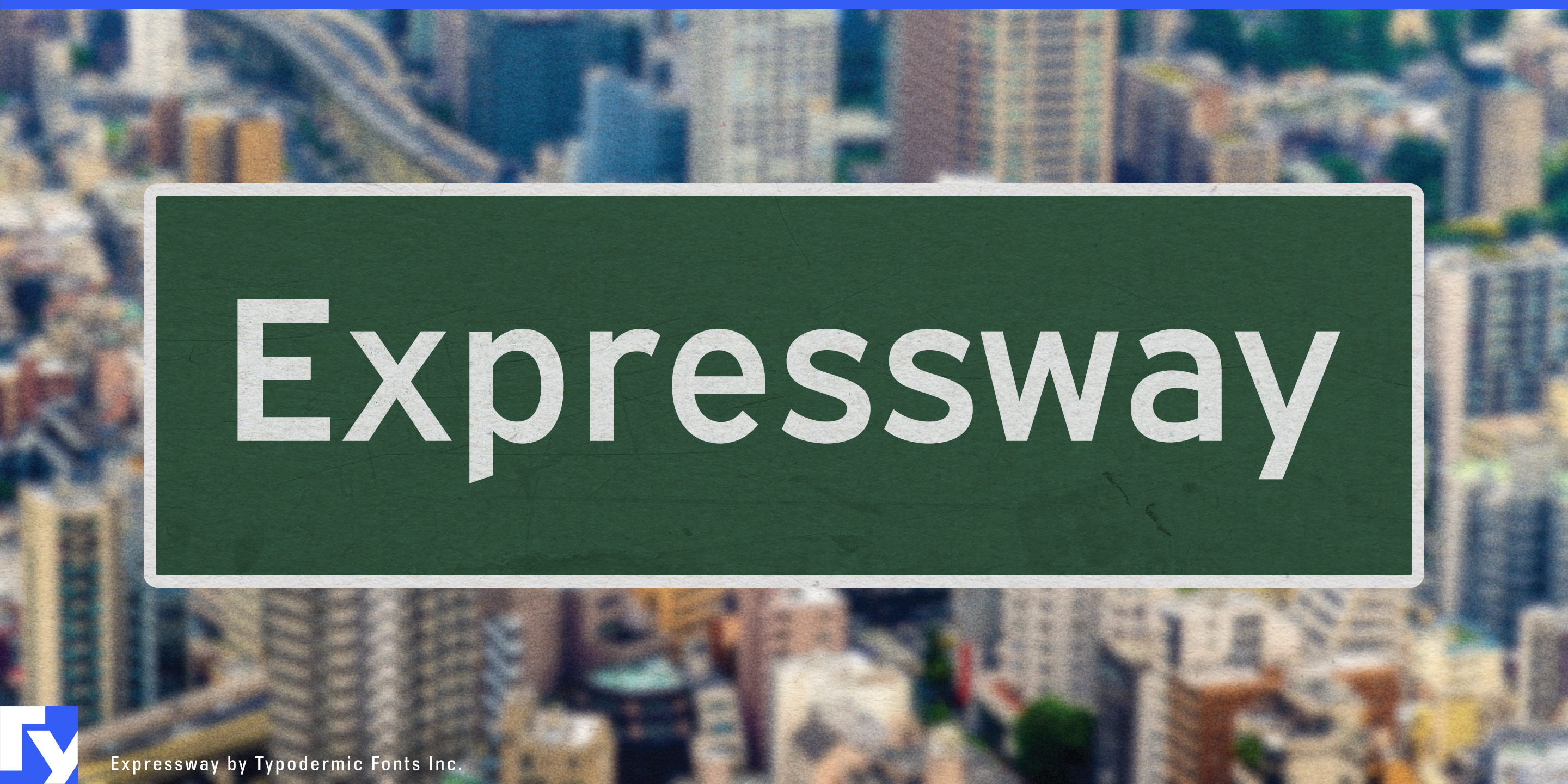
Expressway takes the visual language of the FHWA Series of Standard Alphabets—the lettering familiar from interstate highway signs—and expands it into a family for contemporary transportation and information systems. The connection is recognizable, but Expressway is an interpretation rather than a reproduction: geometric, monoline, and regularized for uses that extend well beyond the roadside.
Modern mobility networks need more typography than destination signs. EV charging stations require bay numbers, rates, availability displays, instructions, and app interfaces. Smart parking systems combine zone identifiers with maps, prices, time limits, and live status information. Mobility hubs, tolling services, roadside assistance platforms, rental fleets, and autonomous shuttle systems all move between physical signs and screens. Expressway gives those pieces a common highway-derived vocabulary.
Seven weights in standard and condensed widths, each with a matching italic, make the family especially useful when information must fit predetermined spaces. Condensed styles can handle long destination names, multilingual labels, narrow control panels, departure displays, and dense maps; wider styles can take over for major destinations, station identities, route names, and large numerical information.
Airports, railway interchanges, coach terminals, ferry ports, parking structures, and large transport campuses have to coordinate gate numbers, platform labels, overhead signs, maps, ticketing screens, service notices, and short instructions. Expressway supports Latin-based European languages, Vietnamese, Greek, and Cyrillic, allowing the same visual system to continue across a broad range of destinations and regional deployments.
The same structure suits freight operators, delivery networks, warehouses, distribution centers, and fleet-management systems. Depot numbers, loading zones, vehicle identifiers, route groups, maintenance information, dispatch dashboards, and shipment-status displays all benefit from a family built around concise labels and repeated numerical information.
Expressway began with the typography of the highway, but its larger territory is the connected system surrounding the road: vehicles, stations, logistics, maps, screens, and the infrastructure that helps people and goods find their way.
Official information and additional styles:
https://typodermicfonts.com/expressway/
Ilustración y compartir

Comentarios de los lectores
Comparte tu opinión o notas de uso sobre esta fuente.
Aún no hay comentarios. Sé el primero.